DEET vs Picaridin vs OLE vs IR3535
Choosing a Mosquito Repellent in 2026
Choosing a mosquito repellent shouldn’t be a 30-minute decision in front of a pharmacy shelf the night before a trip. Four active ingredients dominate the global market — DEET, Picaridin, Oil of Lemon Eucalyptus (OLE), and IR3535 — and the right one depends almost entirely on where you’re going, who’s wearing it, and what diseases circulate at your destination. This guide gives you a side-by-side comparison, a decision tree by scenario, and the citations behind every claim.
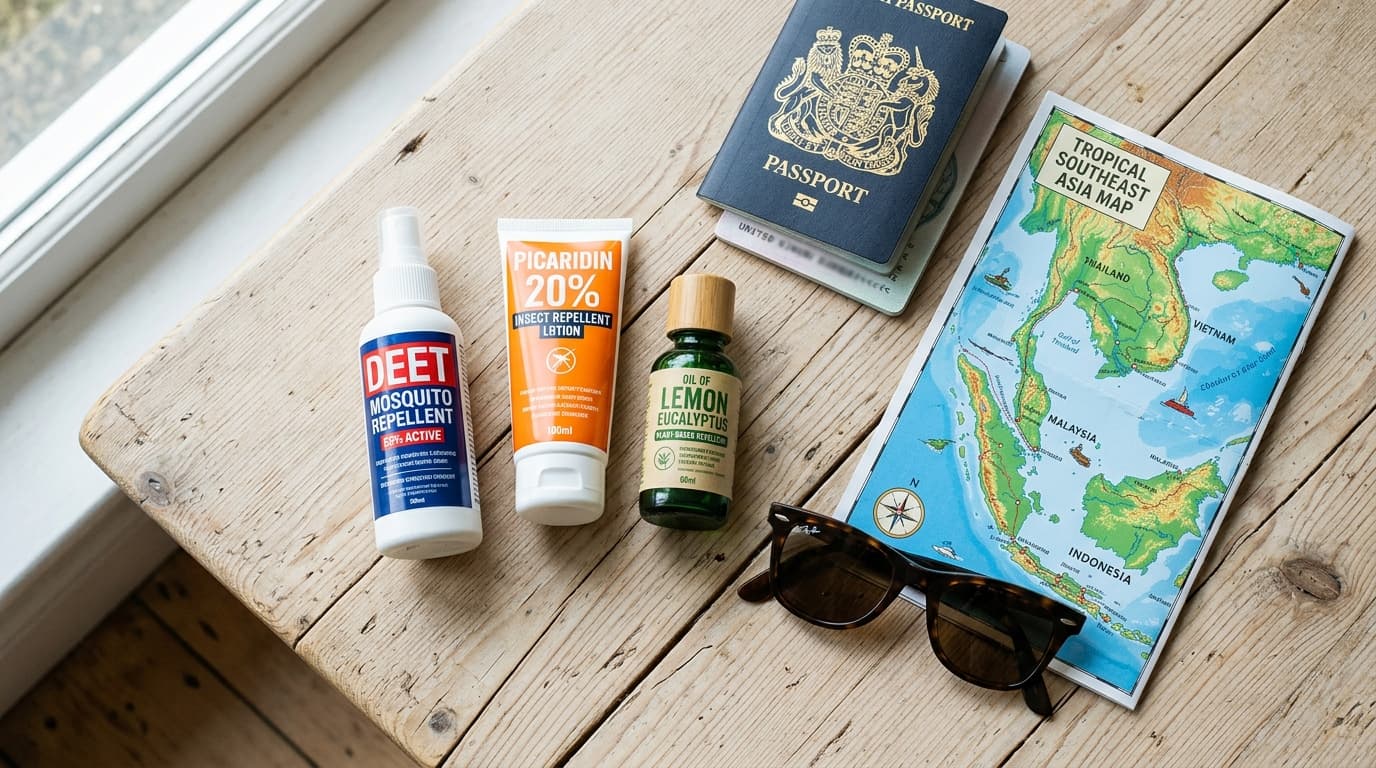
Quick Comparison
Side-by-side, at the recommended concentration for travel use.
| DEET 30% | Picaridin 20% | OLE 30% | IR3535 20% | |
|---|---|---|---|---|
| Hours of protection | 6–8 [1][2] | 8–12 [2][3] | 2–4 [4] | 4–6 [5] |
| Vs malaria-vector Anopheles | Yes [1][6] | Yes — WHO-endorsed [3][7] | Reduced | Reduced [5] |
| Vs dengue / Zika-vector Aedes | Yes [2] | Yes [2] | Yes [4] | Yes [5] |
| Vs ticks | Yes | Yes [2] | Limited | Limited |
| Damages plastics / fabrics | Yes | No [3] | No | Mild |
| Skin feel | Often greasy, strong odour | Light, near-odourless [3] | Eucalyptus scent | Light |
| Minimum age | 2 months [6][8] | 2 months [6][8] | 3 years [4][6] | 6 months [5] |
| Pregnancy-safe | Yes (most data) [6] | Yes [6] | Provider discussion [6] | Yes [5] |
| EPA-registered | Yes [9] | Yes [9] | Yes (as PMD) [9] | Yes [9] |
Choose by Trip
Pick the row that matches your trip; that’s the repellent we’d pack.
DEET 30% or Picaridin 20% on skin, layered with permethrin-treated clothing and a treated bed net. The 2020 review in Infectious Diseases in Clinical Practice found both deliver near-complete protection against malaria-vector Anopheles at recommended concentrations [5]; WHO explicitly endorses Picaridin for malaria-endemic use [7].
Picaridin 20% for comfort; DEET 30% as alternative. Aedes aegypti bites in daylight, so all-day reapplication discipline matters more than overnight protection.
Picaridin 20% is the default. OLE is contraindicated below age three [4][6]; DEET is safe from two months [6] but the fabric- and skin-friendlier profile of Picaridin removes most of the friction with kids and clothes.
DEET is the most-studied option in pregnancy and is recommended by ACOG and the CDC [1][6]. Picaridin also has a strong safety record but less long-term data. Talk to your provider, especially for travel to malaria zones where benefit clearly outweighs risk.
IR3535 20% or OLE 30% is sufficient. Both repel Aedes albopictus (the tiger mosquito now established across the Mediterranean) and Culex. Reserve DEET for trips that warrant it.
DEET 30% on exposed skin plus permethrin-treated clothing. The treated-uniform-plus-skin-repellent combination used by military and field-research personnel reduces bite rates by more than 99% in field studies — neither tool alone matches it.
DEET — The Reference Standard
DEET (N,N-Diethyl-meta-toluamide) has been protecting people from mosquito bites since the US Army developed it in 1946. It is the most studied repellent on the planet, with EPA registration since 1957 and an active-ingredient safety dossier that includes decades of dermal-exposure data [1][9]. At concentrations of 20–30%, it provides 6–8 hours of reliable protection against virtually all biting mosquitoes, including the Anopheles species that transmit malaria [1][2].
Higher concentrations do not repel better — they just last longer. A 30% formulation is the sweet spot for most tropical travel; anything above 50% buys diminishing returns and a stronger smell. The downsides are real but manageable: DEET has a distinctive solvent odour, it can degrade plastics and certain synthetic fabrics, and many people find it greasy on the skin at high concentrations.
DEET is considered safe at recommended concentrations on adults and children aged two months and older [6][8]. The CDC and AAP both recommend it for pregnant women travelling to malaria-endemic destinations, where the benefit clearly outweighs the negligible risk [1][6]. Apply only to exposed skin (not under clothing), avoid eyes and mouth, and wash off when you come indoors.
What we'd pack
Mozzwise may earn a commission on purchases made through these links at no additional cost to you.
Picaridin — The Modern Default
Picaridin (also called Icaridin or KBR 3023) was developed by Bayer in the 1990s and has been steadily gaining ground on DEET ever since. The 2020 review in Infectious Diseases in Clinical Practice and prior field studies (notably Frances et al. 2004 in the Journal of Medical Entomology) found that 20% Picaridin matches 20–25% DEET for both duration and efficacy against Aedes aegypti and Anopheles mosquitoes [2][5]. WHO has formally endorsed Picaridin for use in malaria-endemic areas, putting it in the same operational category as DEET for high-risk travel [3][7].
The practical advantages add up: Picaridin is near-odourless, does not damage plastics or fabrics, feels lighter on skin, and leaves no greasy residue. If you have ever had DEET melt a watch strap or stain a rain jacket, those problems disappear with Picaridin. It is also less likely to provoke skin irritation in sensitive users, which is part of why it is the easier sell to kids and reluctant family members.
For most travel — urban tropics, resorts, family trips, day-long hiking in malaria-free countries — Picaridin 20% is the better default. Below 15% the duration drops sharply, so make sure the product you grab is at the recommended concentration; many drugstore formulations are 5–10% and require more frequent reapplication.
What we'd pack
Mozzwise may earn a commission on purchases made through these links at no additional cost to you.
Oil of Lemon Eucalyptus (OLE / PMD) — The Plant-Based Option
Oil of Lemon Eucalyptus is the only plant-based active recognised by the CDC and EPA as a meaningful repellent [4][9]. The compound that does the work is PMD (para-menthane-3,8-diol), a refined extract — not raw lemon eucalyptus essential oil, which has not been shown to repel reliably. At 30% PMD, OLE provides 2–4 hours of protection against most mosquito species, shorter than DEET or Picaridin but enough for an evening walk or a short hike in low-risk terrain [4].
OLE has a noticeable eucalyptus scent that many people prefer to the solvent edge of DEET. It is a reasonable choice for European city breaks, Mediterranean holidays, or anywhere mosquitoes are a nuisance rather than a disease vector. The single non-negotiable limit is age: OLE is not approved for children under three years old [4][6]. The CDC is explicit on this.
Do not confuse Oil of Lemon Eucalyptus (the registered repellent) with pure lemon eucalyptus essential oil. They are different products with very different evidence bases. If the label does not say "PMD" or "Oil of Lemon Eucalyptus" with an EPA registration number, it is essential oil — and there is no clinical evidence that essential oils repel mosquitoes reliably.
What we'd pack
Mozzwise may earn a commission on purchases made through these links at no additional cost to you.
IR3535 — The European Favourite
IR3535 (ethyl butylacetylaminopropionate) was developed by Merck KGaA in the 1970s and has been a staple of European insect repellents for decades. Avon’s Skin So Soft Bug Guard line is the most familiar consumer brand using it, and Coleman, Sawyer, and various European brands sell IR3535 formulations alongside their DEET and Picaridin products. At 20% concentration, IR3535 provides roughly 4–6 hours of protection against most mosquito species [5].
The safety profile is excellent, which is why IR3535 shows up in many family-oriented and skincare-adjacent products — it is non-greasy, has a mild scent, and does not damage plastics aggressively (though it can mark certain synthetic fabrics). Its weak point is efficacy against Anopheles mosquitoes at high biting pressure; the 2020 IDCP review found it less effective than DEET or Picaridin against malaria-vector species [5]. So it is not the first choice for sub-Saharan Africa or PNG, but it is a sensible default for Mediterranean travel, European summer, and family use where Aedes mosquitoes (dengue, Zika, chikungunya) are the primary concern.
What we'd pack
Mozzwise may earn a commission on purchases made through these links at no additional cost to you.
Layered Protection — More Than Skin Repellent
For any trip into a malaria zone, dense jungle, or extended outdoor exposure, the right strategy is not "more DEET." It is layered protection: skin repellent for exposed skin, permethrin-treated clothing for everywhere fabric covers, and a treated mosquito net for sleeping. Field studies of military and research personnel consistently show that the treated-uniform-plus-skin-repellent combination reduces bite rates by more than 99% — neither tool alone reaches that.
Permethrin is not a repellent in the conventional sense. It is a contact insecticide that binds to fabric and incapacitates any mosquito that lands on treated cloth. One pre-trip treatment lasts six washes (for spray-on products) up to seventy washes (for factory-treated garments). See our [permethrin clothing guide](/guides/permethrin-clothing) for the full process, including the one safety caution: keep wet-treated clothing away from cats.
At the high end of risk — single-night sleep in a rural malaria-zone guesthouse — add a permethrin-treated mosquito net. See our [mosquito nets guide](/guides/mosquito-nets-guide) for net types, mesh density (WHO minimum is 156 holes/sq inch), and setup tips. The combination of skin repellent, treated clothing, and treated net is what people on the ground in endemic areas actually use; it should be what travellers use too.
What we'd pack
Mozzwise may earn a commission on purchases made through these links at no additional cost to you.
Special Cases — Pregnancy, Kids, Sensitive Skin, Pets
Pregnancy: DEET is the most studied repellent in pregnancy and is recommended by ACOG, the CDC, and WHO for pregnant women travelling to malaria-endemic destinations [1][6][7]. Picaridin has a strong safety record but less long-term data; either is reasonable in consultation with your provider, especially when the disease risk warrants protection.
Children: DEET and Picaridin are both approved for infants over two months [6][8]. OLE is not approved below three years [4][6]. IR3535 manufacturers typically list six months as a lower bound [5]. For under-two-months babies, the only protection is physical: tight-mesh stroller and crib covers, long sleeves and trousers in light fabrics, and avoiding peak-biting hours (dawn and dusk for Anopheles; mid-morning and late afternoon for Aedes).
Sensitive skin: Picaridin is the gentlest of the four for most people. OLE has a higher rate of skin reactions because of its terpenoid content; do a patch test before relying on it for a trip.
Pets: Permethrin is acutely toxic to cats — never apply wet permethrin-treated clothing near a cat, and store treated garments away from feline contact until fully dry. Picaridin and DEET are not formulated for pet use; for dogs, use a vet-approved insect repellent designed for animals.
What we'd pack
Mozzwise may earn a commission on purchases made through these links at no additional cost to you.
Travel Insurance and Telehealth — The Other Half of Risk Management
No repellent strategy is 100% effective. For trips to malaria zones, dengue-active regions, or anywhere medical infrastructure is limited, two non-product layers matter as much as your spray choice: travel-medical insurance with evacuation cover, and a plan for what to do if you develop fever within 30 days of return.
Any fever 7–30 days after return from a malaria zone should be treated as potential malaria until proven otherwise — this is the single most important thing for a returning traveller to know. Tell the doctor where you have been and when you were bitten.
What we'd pack
Mozzwise may earn a commission on purchases made through these links at no additional cost to you.
Frequently Asked Questions
Yes — that is one of the main practical reasons travellers switch. Picaridin formulations are water-based and dry to a near-imperceptible feel. DEET above ~15% leaves a slightly oily residue, more pronounced at 30% and above.
No. This is one of Picaridin's signature advantages over DEET. DEET can degrade synthetic fabrics, watch straps, sunglass coatings, and the durable-water-repellent finish on rain jackets. Picaridin leaves all of these alone [3].
For most travellers in most situations, Picaridin 20%. Switch to DEET 30% for malaria zones, dense jungle, or extended outdoor exposure where maximum duration matters and skin comfort takes second priority.
At 20% Picaridin vs 20–25% DEET, multiple studies — including the 2020 review in Infectious Diseases in Clinical Practice and the Frances et al. 2004 field study in the Journal of Medical Entomology — found equivalent efficacy against both Aedes (dengue, Zika) and Anopheles (malaria) mosquitoes [2][5].
Both work. DEET has slightly more published tick-repellency data, but Picaridin 20% performs equivalently in head-to-head testing [2]. For tick zones, permethrin-treated clothing matters more than the choice between the two skin repellents.
Both have strong safety records when used as labelled. Picaridin has fewer reports of skin irritation and is generally considered the gentler choice for daily use. DEET has more total safety data because it has been on the market longer [1][3][6].
No need, and not recommended. Combining them does not increase efficacy and may increase skin irritation. Pick the one that fits the trip and use it consistently.
Yes, with provider awareness. The American College of Obstetricians and Gynecologists permits both DEET and Picaridin in pregnancy [1][6]. DEET has more long-term safety data, which is why guidelines often default to it for pregnant women travelling to malaria-endemic areas.
For dengue / Aedes destinations they are comparable; for malaria zones Picaridin wins clearly because IR3535 is less effective against Anopheles at high biting pressure [5]. IR3535 has a milder profile and is more commonly found in European pharmacies.
No. OLE (as a registered repellent) contains PMD, a refined extract that has been clinically tested. Raw lemon eucalyptus essential oil has not been shown to repel mosquitoes reliably and is not EPA-registered [4][9]. Check the label for "PMD" or an EPA registration number.
Sources
- CDC Yellow Book 2026: Insect Bite & Sting Prevention — US Centers for Disease Control and Prevention (2026) · accessed 2026-06-01
- Field Evaluation of Repellent Formulations Containing DEET and Picaridin Against Mosquitoes in Northern Territory, Australia — Journal of Medical Entomology 41(3): 414 (2004) · accessed 2026-06-01
- WHO Pesticides for Public Health — Repellents Recommendations — World Health Organization (2024) · accessed 2026-06-01
- CDC — Oil of Lemon Eucalyptus / PMD Fact Sheet — US Centers for Disease Control and Prevention (2025) · accessed 2026-06-01
- Efficacy of DEET, IR3535, and Picaridin Topical Use Against Aedes aegypti, Anopheles stephensi, and Phlebotomus papatasi — Infectious Diseases in Clinical Practice 28(6) (2020) · accessed 2026-06-01
- AAP — Choosing an Insect Repellent for Your Child — American Academy of Pediatrics (HealthyChildren.org) · accessed 2026-06-01
- WHO Position on Picaridin for Malaria-Endemic Use — World Health Organization · accessed 2026-06-01
- CDC Yellow Book — Travel and Breastfeeding & Children — US Centers for Disease Control and Prevention (2026) · accessed 2026-06-01
- EPA — Skin-Applied Repellent Ingredients — US Environmental Protection Agency · accessed 2026-06-01
Plan Around These Destinations & Diseases
More Guides
Explore more mosquito intelligence guides for travellers.